
50 CHAIRS
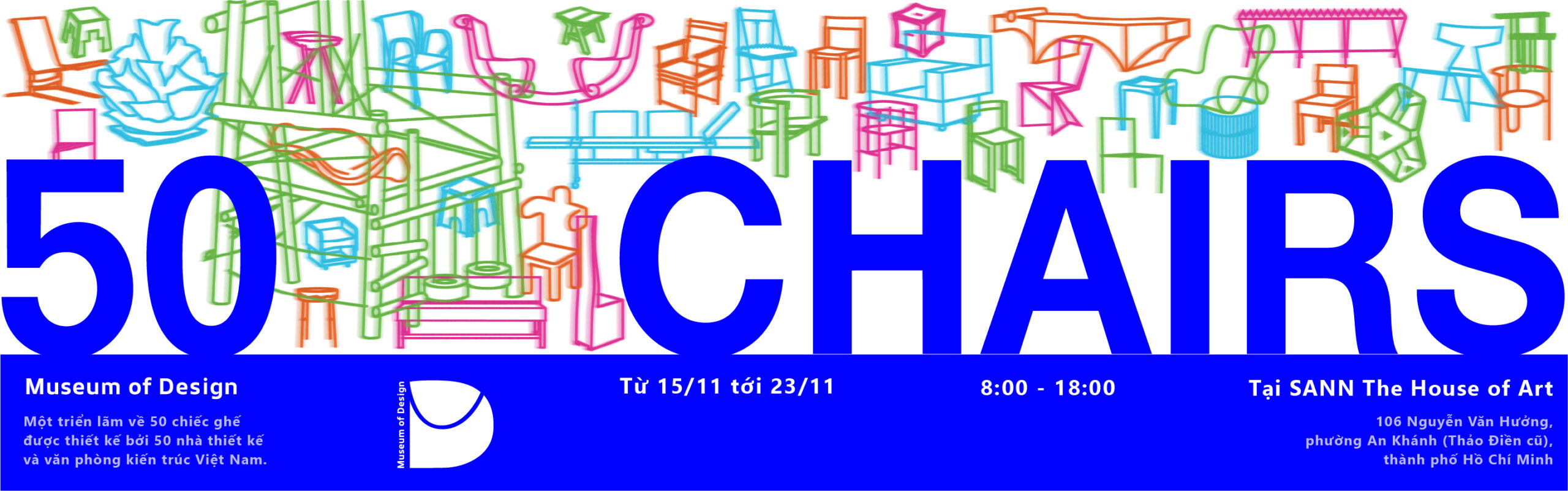
50 CHAIRS | An exhibition featuring 50 chairs designed by 50 Vietnamese designers and architectural studios.
A chair is an interdisciplinary object, as it sits at the intersection of Architecture which deals with spatial structure, Industrial Design which focuses on mass production, and Art which expresses personal aesthetics. A chair is also a form of micro architecture that can reveal or reinforce the integrity within the architectural vision, the Gesamtkunstwerk, of architects from Le Corbusier, Mies van der Rohe, Marcel Breuer to Alvar Aalto, Norman Foster, Alvaro Siza and now Daniel Libeskind, David Adjaye, Ma Yansong and many others.
Designing a chair allows architects to conduct deeper explorations of ergonomics, cultural habits of use, and bodily interaction, thereby expanding the anthropological and sociological dimensions within architecture. Moreover, one privilege of designing chairs is that architects can freely express their own attitude and language, which is why it is widely known that a chair is often among the first architectural manifestos of an architect.
50 CHAIRS | Participant:
324Praxis | Ab.O Design Lab | Choi Object | cưxá.a | Dang & Partners | Đặng Lê Duy | Dao Studio | Exutoire | G+architects | HGAA Architects | HO Studio | Kim, Il Hwan | LAITA Design | NAQI & Partners | Nguyễn Đình Phúc | Nguyễn Minh Hiếu, Trần Quốc Huy, Võ Huỳnh Như | Nemo Studio | Nhabe Scholae | RED5 Studio | sgnhA | STD Design Consultant | Tad.atelier | Timcraft | Tuấn Võ, Phú nguyễn | The Lab | Think Playgrounds | atelier tho.A | Trương Hoài Sơn | Trần Hoàng Long | Trần Quốc Huy | V-Architects | Võ Trần Thanh Quang | VUUV Architecture & Interior Design.






All information and images of the 50 CHAIRS exhibition will be updated and archived by the MoD team in the Press Release.
50 CHAIRS | A Complex Landscape of Contemporary Vietnamese Design and Architecture Through the Form of Chairs
The Museum of Design (MoD) presents 50 CHAIRS, an exhibition where 50 Vietnamese architectural studios express their worldview through a single object: the chair. This is not an exercise in typologies, nor a showcase of materials and technology. The exhibition operates as an open laboratory, placing the chair in its proper position: a tool to measure the depth of design thinking, to interpret culture through a different lens, and to observe the subtle tensions between function, craft, and symbolism. In the context of Vietnamese design entering a phase of self-definition, with the continuous interplay of local and global, handmade and industrial, traditional and innovative, 50 CHAIRS acts as a condensed map of these underlying currents.
The Laboratory of Sitting
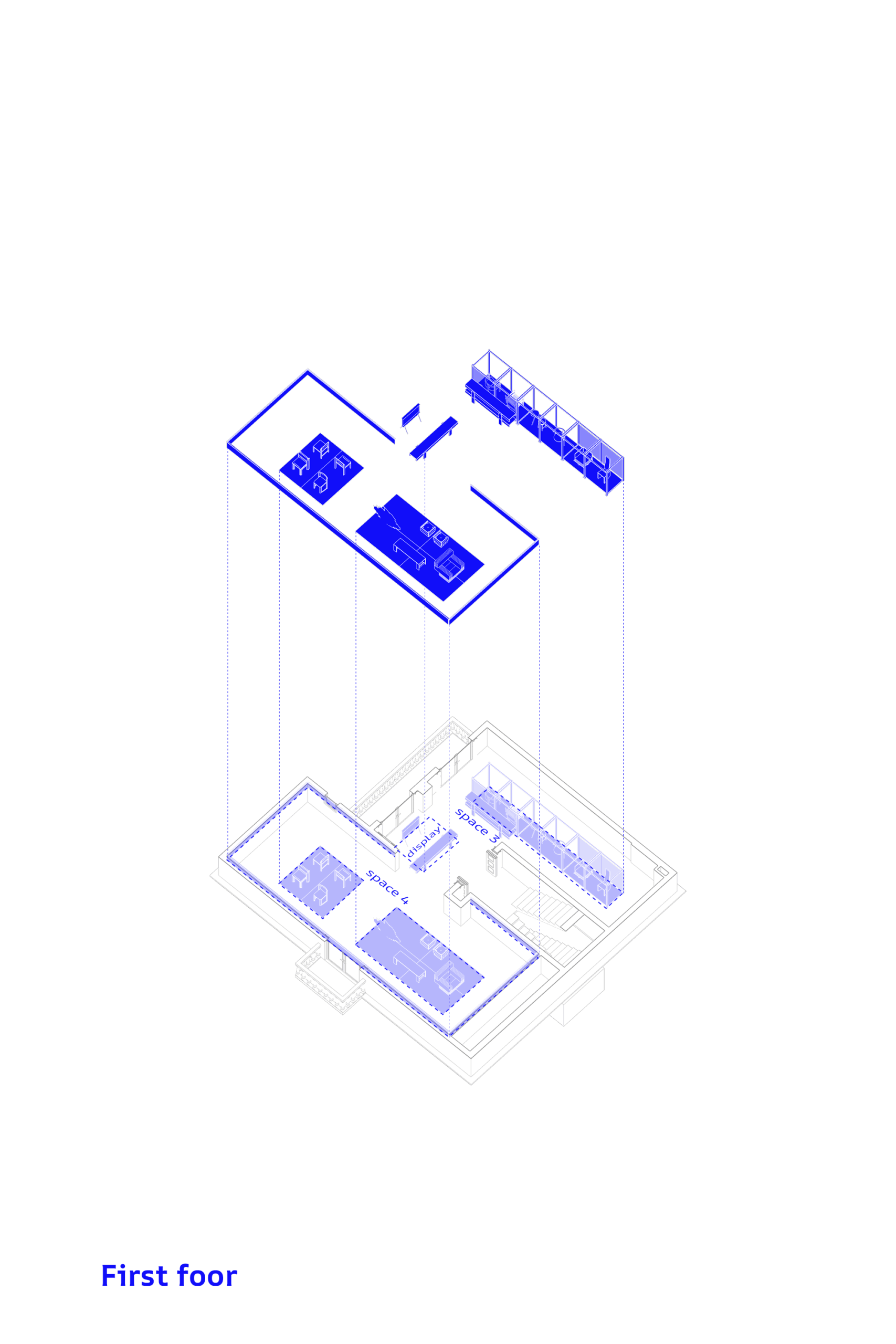
The exhibition comprises four main rooms housed in a multi-story villa, a space originally intended for displaying paintings rather than design. Yet this very context opens the potential for MoD to practice critical thinking and adapt to the environment, reflecting the identity of a decentralized museum like MoD. The existing space is “re-read” and a sensitive, restrained “new layer” is created to “negotiate” with the “existing layer.” Rooms with differing proportions, narrow corridors, unexpected openings, and stairs with indirect lighting all become a structure that guides the rhythm and emotions of visitors.


Passing through Room One, which also serves as the main entrance on the ground floor, visitors are immediately drawn to the reading corner of the 50 CHAIRS book, where publications documenting chair designs and the cultural and historical stories of this object are displayed. However, those who sit to read the book are actually at the end of the exhibition journey. In the context of an exhibition with a high visual density, beginning with reading is a rather bold decision: it stimulates active observation from visitors as soon as they enter.

On the second floor, the rhythm continues to be segmented by the documentary screening space. This is one of the most informative and authentic moments of the entire exhibition: through concise sharing, architects guide viewers through the journey of concept development, context research, material exploration, and making processes. Stories of trial and error, technological limitations, and repeated iterations appear alongside reflections on memory, culture, and environment. This space acts as a transitional chamber, balancing the energy between the four exhibition rooms.
What might seem like a weak point of the building, the location at the stair landings, can actually provide interesting “pauses” between the galleries. MoD uses these areas as units to regulate the pace of the exhibition experience: not so empty as to feel disconnected, yet not so intrusive as to compromise the randomness of the residential architecture.
Material Language: Wood and Fabric as the Foundation of Warmth
Instead of choosing strong industrial materials, MoD decided to use wood and fabric throughout the exhibition: two materials that are familiar, warm, and do not impose an aesthetic on the works. Wood provides physical depth and stability, while fabric regulates sound, light, and atmosphere. This choice softens the competition between the villa’s architecture and the form of the chairs, while also adding the approachable quality MoD aims for in order to engage students and the general public.
The wood and fabric modules are designed to be “invisible”: they do not attempt to showcase craftsmanship, but only support the works. Yet it is precisely this restraint that creates the necessary visual emptiness for each chair to present its own story. In other words, one could say this is the “chair” of the chairs themselves.


A Multi-Level Exhibition: Guided by Material and Rhythm
One of the strengths of the 50 CHAIRS space lies in the way the works are “illuminated” through material and spatial rhythm. The experience rises and falls like waves: expanding, compressing, pausing, and then opening up again. The multi-level structure of the villa becomes the framework for this journey, while MoD’s interventions act as the emotional scaffolding.
Visitors can clearly sense the changes in light temperature, sound density, materials, and spatial emptiness as they move from one room to another. The entire journey tells a story of material, light, and form.

Chairs as a Mind Map
The chair is a very special object in design because of its inherently “dialogical” presence. Its scale is close to the human body, directly relating to the spine, center of gravity, and breathing, while evoking a wealth of memories of sitting, waiting, conversing, working, and reflecting.
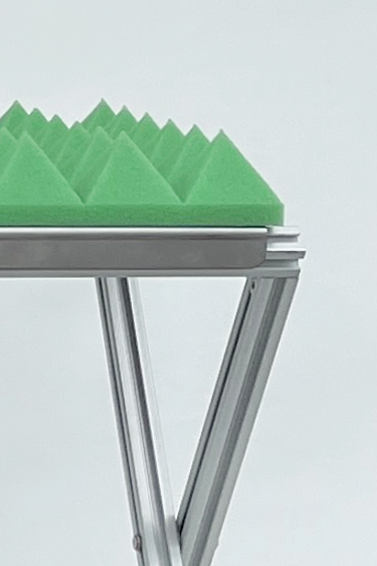
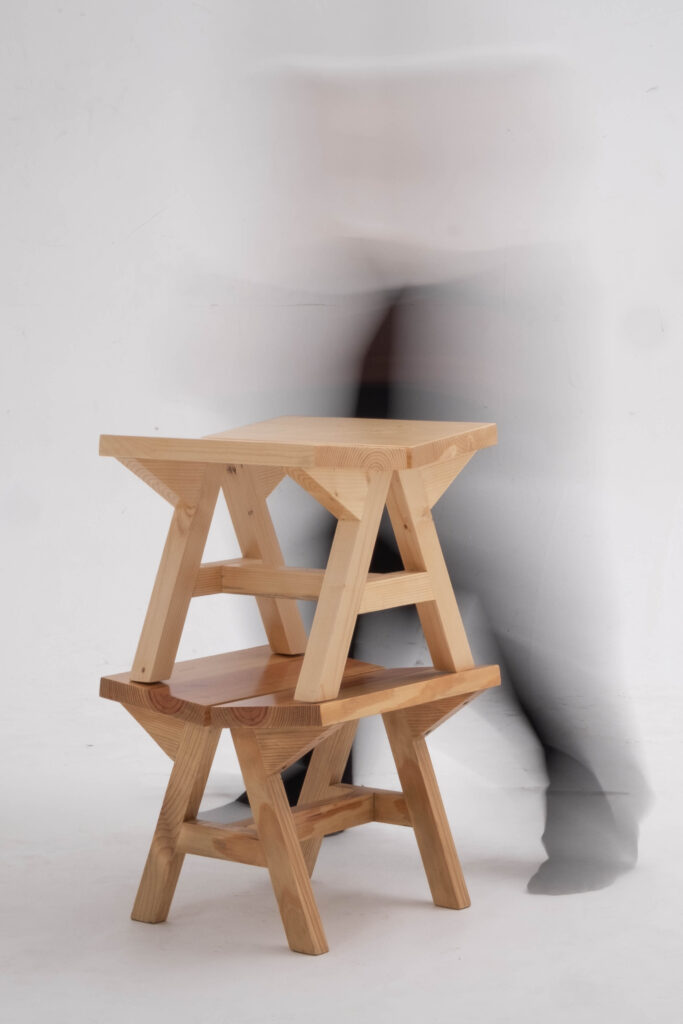
In 50 CHAIRS, the chairs are not strictly categorized or arranged by strong thematic divisions. MoD rejects linear interpretation in order to preserve the disorder, which is the inherent nature of contemporary design thinking. Visitors may encounter: experiments with curved structures simulating physical movement; studies of new materials, from lightweight foam to handcrafted laminated wood; minimalist and refined forms resulting from rigorous refinement processes; chairs that emphasize cultural narratives, with shapes recalling traditional architecture, daily habits, and informal structures of Vietnamese streets; or hybrid models blending furniture, sculpture, and small-scale architecture.
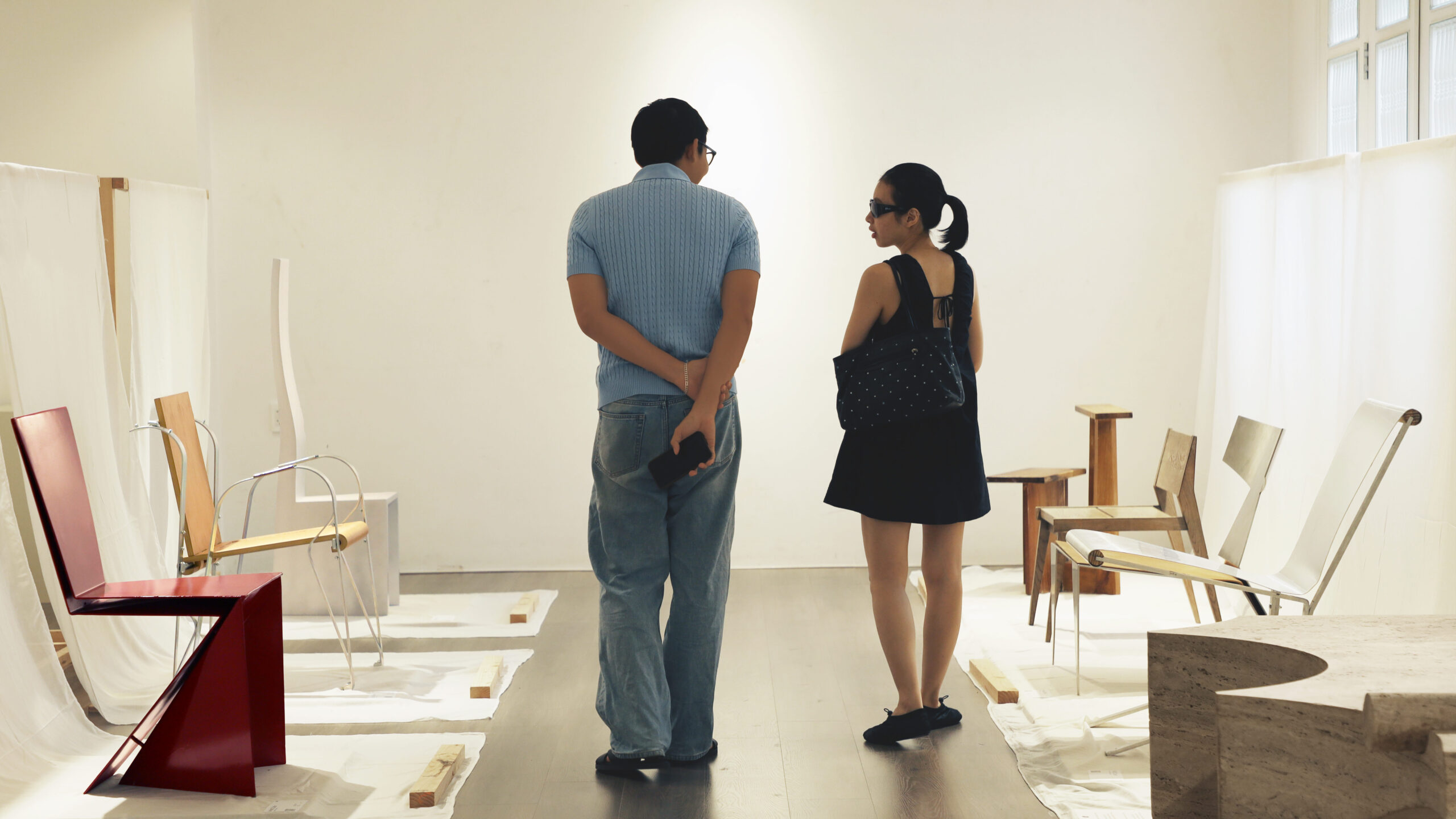
What unites all the works is a sense of seriousness. None of the pieces give the impression of being “rushed” or designed to boost reputations. This diversity not only demonstrates the capabilities of each architectural studio and designer but also maps out the clusters of ideas currently shaping design in Vietnam.
Installation Method, Operation, and Logistical Imprint
Unlike many design exhibitions that focus solely on finished products, MoD also utilizes leftover materials to craft chairs and reading tables, display shelves for models, benches, stools, small armchairs, and more to support the exhibition’s operation. It is thanks to these items that spaces such as the welcome courtyard can be rearranged for the opening night, or that the large Room Four can be temporarily transformed for a book launch in a way that feels purpose-built for the event. This creates a coherent flow between gathering, displaying, operating, and experiencing, while also reducing material waste.
This approach reflects a clear attitude: design is not just the final object but the entire process leading to it. MoD seriously considers the lifecycle of materials, the local production ecosystem, and the sustainability of exhibition practice and operations.

Design Is for Everyone
MoD consistently emphasizes that design must have the capacity to reach beyond the professional sphere. 50 CHAIRS is built as a naturally educational platform: accessible and easy to observe, yet without simplifying the content. For students, the chair is the most familiar object through which to explore design concepts and the mindset of making objects. For the design community, it offers an opportunity to recognize their professional context through 50 parallel voices.
The exhibition space therefore completely avoids “performance” or theatricality. Instead, MoD adopts a neutral approach: clear and deliberate, allowing visitors to engage with the works at their own pace.
50 Chairs as 50 Fragments of Memory, Present, and Future of Contemporary Vietnamese Design
When placed together, the 50 chairs unintentionally create a cumulative story that extends beyond each individual piece. It tells the story of a generation of Vietnamese designers and architects searching for their own voice. There is hesitation, there is boldness; reflection and experimentation; nostalgia alongside efforts to break away from tradition.


MoD does not try to impose anything that could become a “representative image.” The exhibition does not aim to provide final answers but instead opens up a system of questions: What shapes the identity of contemporary Vietnamese architecture and design? How are Vietnamese designers and architects engaging in dialogue with the world? How far can a small object like a chair project dimensions of thought about culture, society, and technology?
50 CHAIRS treats the chair as a “fundamental research unit” carrying condensed information about people, context, and profession. It is an object capable of encompassing 5,000 years of dialogue between form and body, between function and symbolism.

The exhibition operates smoothly thanks to the combination of the curatorial thinking of the Design Committee (DC), the spatial flexibility of the villa, and MoD’s consistent perspective: design is for everyone. 50 CHAIRS does not aim to showcase brilliance but chooses a clearer path: to let each chair speak for itself, and to let each visitor read for themselves.
In the context of Vietnamese design quietly evolving in many directions, 50 CHAIRS offers a moment to pause, reflect, and observe both the diversity and the invisible connections that are shaping contemporary Vietnamese design.


